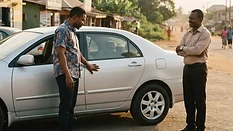

How to Inspect a Used Car Before Buying in Nigeria
A practical, take-it-with-you guide to inspecting a used car in Asaba before you pay — exterior, engine, interior, test drive, documents and the warning signs that mean walk away.
Buying a used car is a major purchase, and the most important rule is simple: inspect before payment. Never make a final payment based only on listing photos, a seller's claims, or how clean the vehicle looks on arrival. This guide explains what to check before you pay for a used car in Asaba, so you can decide with confidence rather than under pressure. Inspection is one part of the complete used-car buying process in Asaba; this guide focuses on the physical and mechanical checks.
A car that looks excellent in photographs can hide expensive problems — body repairs, engine faults, worn suspension, document inconsistencies, or warning lights that only appear under the right conditions. The steps below help you inspect methodically. You do not need to be a mechanic to use them, but they will tell you when to bring one.
1. Before You Go to See the Car
Start your inspection before you leave home. Read the listing carefully and note:
- The asking price, and how it compares to similar year/make/model listings.
- The stated year, make and model.
- The claimed condition (foreign-used, locally used, or new).
- The stated mileage.
- The location of the vehicle.
- Every photo provided — including angles, interior shots, and any image that looks retouched or tightly cropped.
- The seller or dealer name and any reputation information you can find.
If details are vague, photos are missing, or the price only makes sense if you skip verification, ask your questions before you travel. Inconsistencies are far cheaper to resolve by message than after a long trip.
A few things to bring: a torch, a small mirror ( for seeing under the car or behind panels ), gloves, a phone for photos, paper and pen, and ideally an OBD scanner or a friend who knows cars. These do not replace a mechanic, but they make your own check far more useful.
2. Inspect the Vehicle in Daylight
Inspect the car in daylight, outdoors, and ideally in dry weather. Daylight makes it far easier to identify:
- Paint mismatch and uneven shine.
- Dents, scratches and panel differences.
- Rust, especially around wheel arches, door sills and the underbody.
- Cracked or foggy lights.
- Poor body repairs and uneven panel gaps.
A nighttime inspection, or a car parked in a dim garage, can hide exactly the problems you most need to see. If you can only view at night, schedule a second daytime visit before you pay.
3. Inspect the Exterior and Body
Work around the car systematically and check:
- Front and rear bumpers.
- Bonnet and boot/tailgate, and how they open, close and align.
- All doors — open and close each one; listen for creaks and check the gaps.
- Roof and pillars.
- Panel gaps — they should be reasonably even on both sides of the car.
- Headlights, taillights and indicators ( cracks, moisture inside, function ).
- Windscreen and windows for chips or cracks.
- Mirrors.
- Tyres — tread depth, matching sizes, even wear, and age — and wheels.
Repainting alone does not automatically make a car bad — a panel may have been resprayed after a minor scrape. What matters is understanding why a repair was done and whether structural damage lies underneath. Ask the seller about any panel that looks repainted, and note inconsistent answers.
4. Check for Accident or Structural Repair Signs
Look for warning signs of more serious repairs:
- Inconsistent or amateur-looking welds.
- Distorted or uneven chassis areas.
- Panels that do not align with neighbouring panels.
- Overspray on rubber seals, trim or glass.
- Unusual or excessive sealant in areas that should be clean.
- Mismatched paint between adjacent panels.
- Badly repaired crumple zones at the front or rear.
A visual inspection cannot conclusively prove accident history. It can only flag signs that deserve further investigation. If anything looks structurally unusual, do not rely on your own judgement — get a professional inspection before paying.
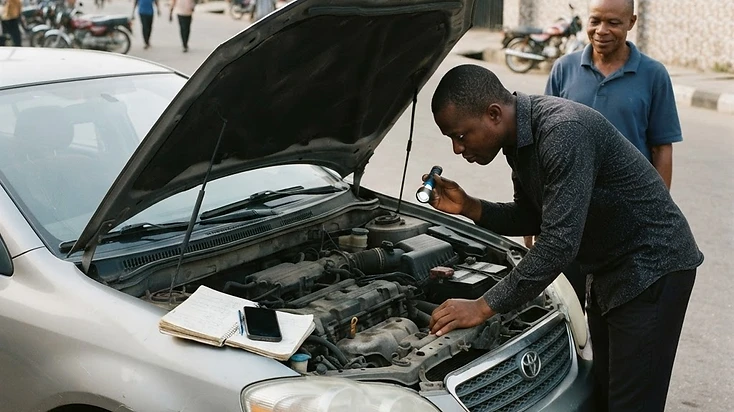
5. Inspect the Engine Bay
With the bonnet open, check:
- Oil level and condition — look for a clean, amber-to-dark colour. Thick, milky ( which can suggest coolant mixing ) or gritty oil is a concern.
- Coolant level and colour — it should be within range and free of oil scum.
- Visible leaks around the engine, gearbox and hoses.
- Belts and hoses — cracked, frayed or perished rubber should be questioned.
- Battery terminals and mounting — corrosion and loose clamps.
- Unusual modifications or non-standard wiring.
- Strange noises on startup.
- Smoke from the exhaust — blue, white or heavy black smoke each suggest different issues.
- How the engine behaves after it warms up — steady idle, no misfires.
Where practical, ask the seller to start the engine cold. An engine that is already warm can sometimes hide cold-start problems such as rough idling, smoke or unusual noise that disappear once the engine reaches operating temperature.
6. Check the Interior
Inside the car, check:
- Dashboard warning lights ( covered in the next section ).
- Air conditioning — does it cool effectively, and does the fan work on all speeds?
- All windows, including electric windows up and down.
- Central locking and individual door locks.
- Infotainment, speakers and connectivity.
- Seat adjustment and seat belts — retract and latch properly.
- Steering wheel controls and stalks.
- General interior wear, and the boot floor / spare tyre area.
Interior wear should broadly make sense relative to the claimed mileage — a very low-mileage car with heavily worn seats or steering wheel deserves a question. But wear alone cannot prove mileage manipulation; it is one signal among many, not proof on its own.
7. Start the Vehicle and Watch the Dashboard
When the key is turned ( or the start button pressed ), certain warning lights should illuminate as part of the startup self-check, then switch off. Pay attention to:
- Check engine light.
- ABS ( anti-lock braking ) light.
- Airbag light.
- Battery / charging warning.
- Oil pressure warning.
A light that stays on after startup, or one that was deliberately hidden, is a reason to stop and investigate. Do not attempt an unsafe mechanical diagnosis yourself — get warning lights professionally scanned and explained before you pay.
8. Test Drive Before Payment
A vehicle that looks excellent while parked may reveal problems on the road. If the seller refuses a reasonable test drive, that is itself a red flag. Drive on a route that includes stop-start traffic, an open stretch, and some uneven road. During the drive, assess:
- Steering — is it straight, smooth and free of wandering or vibration?
- Braking — firm and progressive, without pulling to one side.
- Acceleration — smooth, without hesitation or surging.
- Transmission behaviour — clean gear changes, no slipping, no harsh shifts.
- Suspension noise over bumps.
- Vibration at speed.
- Wheel alignment symptoms — pulling to one side, or a steering wheel that sits off-centre on a straight road.
- Engine temperature — it should stay in the normal range.
- Any unusual sounds, smells or smoke.
9. Verify the Vehicle Documents
Make document checks Nigeria-relevant. Verify the documents appropriate to the particular vehicle and transaction, and check consistency between the vehicle, the VIN/chassis information, and the documents presented.
This guide does not provide legal guarantees. Document requirements and validity can vary, so obtain professional, legal or official verification wherever the ownership, registration or customs status of a vehicle is unclear.
10. Verify the VIN/Chassis Number
- Compare the physical VIN/chassis number on the vehicle with the number on the documents.
- Look for signs of tampering, restamping or mismatched plates.
- Use legitimate history or verification sources where available.
Be aware that online vehicle-history information may be incomplete. It should support, not replace, physical inspection and document verification.
11. Tokunbo vs Locally Used Inspection Differences
Both foreign-used ( tokunbo ) and locally used vehicles require inspection. Neither category is automatically better.
For foreign-used vehicles, buyers may want additional attention on:
- Imported history where available.
- Previous damage.
- Flood indicators — moisture, corrosion in odd places, electrical oddities.
- Underbody condition.
- Mileage consistency.
For locally used vehicles, give extra attention to:
- Maintenance history.
- Suspension and steering.
- Cooling system and AC.
- Tyres.
- Electrical repairs.
- Accident repairs.
- Documentation and ownership continuity.
12. Bring an Independent Mechanic or Inspector
Wherever practical, the person inspecting the vehicle should represent your interests, not the seller's. An independent mechanic or professional inspector can:
- Run a diagnostic scan for hidden fault codes.
- Perform a physical and mechanical inspection beyond what a visual check can reach.
- Give you a written opinion you can use in negotiation.
The cost of an inspection is small compared to the cost of discovering a serious fault after payment.
13. Red Flags — When to Walk Away
Walk away, or at least pause, if you notice:
- The seller refuses an inspection.
- Pressure to pay immediately or "today only".
- VIN or document inconsistencies.
- The seller refuses a reasonable test drive.
- Unexplained warning lights.
- Serious structural concerns or poor repairs.
- Unclear ownership or documentation.
- Major claims ( low mileage, no accident, perfect history ) that cannot be verified.
- A price that only makes sense if you skip verification.
A low price alone does not mean fraud. But a price that only works if you avoid verification is a warning, not a bargain.
14. Used Car Inspection Checklist
Screenshot or save this checklist and take it with you.
BEFORE PAYMENT
- [ ] Confirm vehicle identity
- [ ] Inspect exterior
- [ ] Inspect chassis/structural areas
- [ ] Inspect engine bay
- [ ] Cold start where practical
- [ ] Check dashboard warning lights
- [ ] Test AC and electronics
- [ ] Inspect tyres
- [ ] Test drive
- [ ] Check transmission behaviour
- [ ] Check braking and steering
- [ ] Verify VIN/chassis
- [ ] Review documents
- [ ] Bring mechanic/inspector where appropriate
- [ ] Resolve unexplained warning signs
- [ ] Agree transaction terms clearly
- [ ] Pay only when satisfied with verification
Final Recommendation
A clean-looking car is not enough. The safest buying process combines:
- Physical inspection
- Mechanical inspection
- A road test
- VIN and document verification
- Clear, agreed transaction terms
Use what you find to negotiate honestly. Minor cosmetic wear is normal for a used car and may justify a fair price adjustment rather than a reason to walk away. The issues that truly matter are structural, mechanical, or documentary — those are where you pause, bring an expert, or decline.
If anything cannot be verified, you have the right to wait, to get a second opinion, or to walk away. The principle that protects you throughout this guide is the one you started with:
Inspect before payment.
When you are ready to compare vehicles, browse cars for sale in Asaba and apply these inspection steps before you pay — a marketplace listing is not a substitute for inspecting the specific car in front of you.