
Common Used Car Scams in Nigeria: Red Flags Before You Pay
A practical buyer's guide to recognizing used car scam red flags in Nigeria — fake listings, deposit pressure, payment inconsistencies and seller identity gaps — and how to verify before you pay.
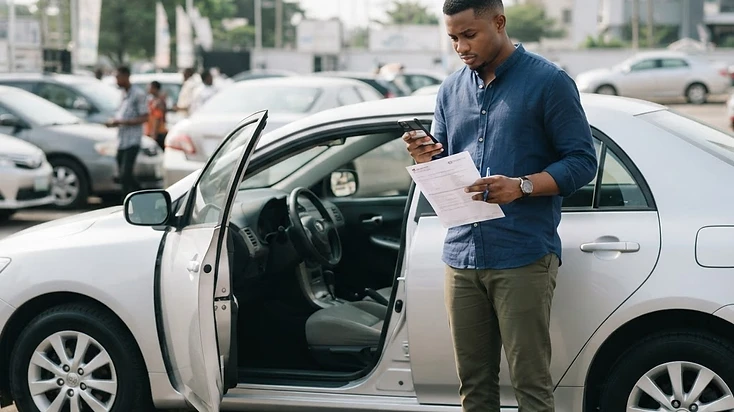
Used car transactions in Nigeria can be genuine and rewarding. Most sellers — dealers, agents and private owners — are honest people moving real vehicles. But expensive purchases, incomplete information, time pressure and emotional excitement can create opportunities for deception. This guide helps you recognize specific risky patterns before money moves. Transaction safety is one part of the complete used-car buying process in Asaba; this guide focuses on scams and red flags, while inspection and verification are covered separately.
The objective is not to make you afraid of every seller. It is to help you slow down, ask the right questions, and verify the vehicle and the transaction before you pay.
DO NOT PAY BECAUSE THE STORY SOUNDS CONVINCING. VERIFY THE VEHICLE, VERIFY THE TRANSACTION, INSPECT BEFORE PAYMENT.
This is a scam-recognition and transaction-safety guide. It does not replace physical inspection or document verification — where deeper checks are needed, we link to our companion guides.
1. Why Car-Buying Scams Work
A used car is an expensive, complex purchase. Most buyers are not mechanics, and a vehicle's true condition is not obvious from a clean exterior. Sellers often know more than buyers, and the transaction usually happens under some time pressure.
That information gap, combined with urgency and the emotional pull of a car you already picture yourself driving, is exactly what a dishonest operator relies on. You do not need to be careless to be misled — only rushed, excited, or reluctant to ask an awkward question.
None of this means Nigerian car sales are generally fraudulent. Legitimate dealers, agents and private sellers exist in large numbers. The goal is to recognize specific behaviours that increase risk, not to treat every transaction as suspicious by default.
2. Scam vs Bad Deal vs Bad Car
Not every disappointing purchase is a scam. Keeping these categories separate helps you respond correctly.
- Deliberate deception — a seller who knowingly misrepresents a vehicle, identity, document or transaction to take your money. This is a scam.
- A bad deal — a vehicle sold at a price high relative to condition or market value, without deliberate concealment. A poor purchase, but not automatically fraud.
- A bad car — a vehicle with real mechanical or cosmetic problems, disclosed or not. A problematic vehicle does not prove the seller committed fraud.
- A misunderstanding — conflicting expectations about condition, price, repairs, or what was included.
- Incomplete information — a seller who simply did not know everything about the vehicle, rather than hiding something.
A scam involves intent to deceive. A mechanically poor vehicle, an overpriced deal, or an honest gap in knowledge is not the same thing.
3. Fake or Copied Car Listings
Some listings are not what they appear. Patterns worth investigating include:
- Photos that appear copied from another listing or website.
- A vehicle advertised by someone who cannot conveniently produce it for inspection.
- Conflicting descriptions across the listing or the seller's different posts.
- Suspiciously vague or changing location information.
- Refusal to allow a physical inspection.
- Repeatedly changing the agreed meeting location.
- Any request for money before you have seen the vehicle in person.
None of these individually proves fraud. Photos can be re-used by mistake, and a seller may have a legitimate reason to meet at a neutral location. But each item is a reason to ask a clear question. The danger is a pattern of odd details with no satisfactory explanation, not a single one.
4. The Unrealistically Attractive Offer
A price that seems unusually good should trigger additional verification, not automatic excitement. The right response to a surprisingly low price is to ask why, calmly, and test the answer.
LOW PRICE ≠ AUTOMATIC SCAM.
LOW PRICE = REASON TO ASK WHY.
There are honest reasons a vehicle might be priced aggressively — a seller who needs to sell quickly, an older model, higher mileage, or a seller who has already replaced it. But an attractive price combined with pressure to pay before inspection, refusal to allow verification, or an inability to produce the vehicle should make you slow down.
Compare actual asking prices for actual vehicles, and judge each price against the specific car, not against a label.
5. Deposit Pressure Before Inspection
Deposit requests are common in Nigerian car transactions, and a deposit is not automatically fraudulent. Many genuine transactions involve a token to hold a vehicle. The risk increases when a deposit is requested before you can independently confirm the vehicle, the seller, or the terms.
Phrases worth pausing over:
- "Send something now so I hold it for you."
- "Another buyer is already coming, so pay a commitment fee."
- "Pay a deposit before inspection so I know you are serious."
Before paying any deposit, understand who receives the money, why it is requested, whether it is refundable and under what conditions, which vehicle it relates to, and whether the person requesting it has authority to sell.
A deposit paid before you have seen, verified and inspected the vehicle carries more risk than one paid after those steps. This is not a rule against deposits in every situation — it is a rule to understand what you are paying for and to whom.
6. Fake Urgency and Emotional Pressure
Urgency is normal in car sales — vehicles do sell, and a seller may genuinely have other interested buyers. But urgency should never remove verification. Pressure to skip the steps that protect you is itself a red flag, regardless of whether the underlying hurry is real.
Examples: immediate transfer demands with no time to think; repeated pressure to skip inspection; discouraging questions, a mechanic, or VIN and document checks; a price that supposedly disappears within minutes.
A genuine seller can usually tolerate a short delay for inspection and verification. If a few hours of due diligence would lose you the vehicle, weigh that against paying for a car you have not properly checked.
URGENCY SHOULD NEVER REMOVE VERIFICATION.
7. Seller Identity Does Not Match the Transaction
It is common in Nigeria for a vehicle to be sold by someone other than the registered owner — an agent acting for an owner, a dealer selling on consignment, or a representative handling a sale. These arrangements are not automatically fraudulent. The buyer simply needs to establish the relationship clearly before paying.
Questions worth asking: Who is the registered owner? What is the relationship between the seller and the owner? Does the seller have authority to sell and to receive payment? Where is the payment actually going?
When identity and authority are unclear, that is a reason to verify further, not a reason to pay faster.
8. Payment Account Red Flags
The destination of your money matters as much as the price of the vehicle. Patterns worth pausing over:
- An unexpected change of account shortly before payment.
- Payment requested to an unrelated third party with no clear explanation.
- A different account sent at the last minute.
- Pressure to split payments across multiple accounts without a reason.
- An account holder whose identity does not match the seller or the transaction.
This is not a claim that legitimate transactions must always use one particular account type. Businesses, agents and representatives can legitimately use various accounts. The principle is consistency and verification: the person receiving the money should match the person selling the vehicle, and any change should have a clear, verifiable reason.
When the payment destination keeps shifting, treat it as a reason to confirm before you transfer, not after.
9. Fake Proof of Payment and Transaction Confusion
Transaction-side confusion can affect both buyers and sellers. A buyer may be shown a fake receipt, or a seller a fake transfer notification. The defensive guidance is the same in either direction:
- Verify any receipt through the actual financial institution or account, not through a screenshot alone.
- Do not rely only on images of confirmations.
- Confirm that funds have actually arrived independently before releasing a vehicle or document.
- Keep your own transaction records — reference numbers, timestamps and account details.
Rely on independent confirmation from your bank or payment platform rather than on a document handed to you by the other party. If the only evidence of a transfer is a screenshot, you have not confirmed it.
10. The Vehicle Does Not Match the Advertisement
Sometimes the vehicle presented is not the one advertised: a trim or model-year inconsistency, major advertised features missing, a condition materially different from the photographs, mileage that does not fit the vehicle's age or wear, a colour or interior that differs, or a different vehicle entirely on arrival.
A single minor discrepancy can be an honest mistake. A pattern of discrepancies is a reason to stop and ask. This is not a full inspection checklist — for the physical and mechanical side of confirming what the vehicle actually is, see How to Inspect a Used Car Before Buying in Asaba.
11. "Accident Free" and Similar Claims
Marketing phrases such as "accident free", "clean title" or "first body" are common in listings. These claims should be independently evaluated, not accepted on the seller's word. A visual inspection alone does not conclusively prove or disprove accident history, and a repaired vehicle is not automatically unsafe.
What matters is that the claim is testable. Ask for its basis, then check it against the physical evidence and the documents. The next section covers the document side.
12. VIN, Chassis and Document Inconsistencies
If the VIN, the chassis number, the registration documents or the customs papers show inconsistencies, that requires investigation before payment. A mismatch between a vehicle's physical identity and its paperwork is a serious issue regardless of how good the price looks.
This section is deliberately short, because the full verification process is covered in our companion guide. If anything in the vehicle's identity or documents does not line up, read How to Verify a Car Before Buying in Asaba before you proceed.
13. Remote Purchase Risk
Buying from another city or state adds distance between you and the car — exactly what a dishonest operator prefers. Remote purchases cannot be made risk-free from photos and messages alone.
A safer remote approach includes: a live video inspection of the actual vehicle (not pre-recorded clips); a trusted representative to view it in person; an independent mechanic where possible; confirmation of the vehicle's identity before payment; verification of the seller's identity and authority; transaction documentation; and no full payment based only on photos and messages.
A deposit to hold a vehicle for a remote inspection may be reasonable, but the same deposit questions apply: who receives it, why, and on what terms. Distance does not reduce your need to verify — it increases it.
14. Social Media and WhatsApp Listing Risks
Social media platforms and WhatsApp are legitimate sales channels, and many genuine vehicles change hands through them. A profile, page, or group membership does not by itself prove trustworthiness, but it does not prove dishonesty either.
Reasonable checks: consistency of the seller's identity across posts and messages; a history of activity rather than a brand-new account with one listing; a visible business presence or verifiable references where claimed; and whether the vehicle can actually be inspected physically and matches the listing.
A large follower count does not guarantee legitimacy, and a "verified-looking" profile does not guarantee safety. Treat the listing like any other: verify the vehicle, verify the seller, inspect before payment.
15. Dealer, Agent and Private Seller — Risk Is Behaviour-Based
No seller category is automatically safe or unsafe. The label on the seller matters far less than how the transaction actually behaves.
- A dealer can be legitimate, with a real location and real inventory — or problematic, with misrepresentation and pressure tactics.
- An agent can be legitimate, acting honestly for an owner — or problematic, with unclear authority and shifting stories.
- A private seller can be legitimate, selling their own car transparently — or problematic, with a vehicle and identity that do not match the story.
Evaluate evidence and transaction behaviour, not the seller type. A clean dealership still deserves verification; a private seller with a clear story still deserves inspection.
16. Common Red Flags Before Payment
A concise, decision-oriented checklist to take with you.
- The vehicle cannot be inspected before payment.
- The seller refuses reasonable verification of identity or documents.
- The identity story keeps changing.
- The payment destination unexpectedly changes.
- Details conflict across the listing, the messages and the vehicle itself.
- There is pressure to skip a mechanic's inspection or VIN and document checks.
- There is unexplained, escalating urgency.
- The seller is unwilling to document important transaction terms.
One red flag does not automatically prove fraud. A single odd detail can have an honest explanation. Multiple unresolved inconsistencies, however, justify slowing down or walking away.
17. What Is NOT Automatically a Scam
This list matters as much as the red flags above. Each of the following is common in honest transactions and is not, by itself, evidence of a scam:
- A seller asking for a deposit.
- An agent selling a vehicle for an owner.
- A dealer selling another dealer's vehicle.
- A vehicle that has been repaired in the past.
- A locally used vehicle.
- A Tokunbo vehicle.
- A vehicle priced below average.
- A seller who appears to be in a hurry.
- A payment made to a named business representative.
None of these is automatically suspicious. What matters is context and verification. A deposit paid after inspection to a verified seller is very different from a deposit paid before inspection to someone whose identity you cannot confirm.
This is why blanket rules — that any deposit is inherently fraudulent, that all agents should be avoided, or that any low price must be dishonest — are not useful. Judge each transaction on its own evidence.
18. A Safer Pre-Payment Sequence
A simple, practical buyer workflow:
- Step 1 — Confirm the actual vehicle exists. See it in person, or through a verified live inspection if remote.
- Step 2 — Confirm who is selling it. Establish the seller's identity and authority to sell.
- Step 3 — Verify the vehicle identity and documents. Check the VIN, chassis and papers. See How to Verify a Car Before Buying in Asaba.
- Step 4 — Inspect the physical and mechanical condition. See How to Inspect a Used Car Before Buying in Asaba.
- Step 5 — Understand the agreed price and transaction terms. Write them down so both sides agree.
- Step 6 — Confirm where payment is going. The account should match the seller and the transaction.
- Step 7 — Pay only when unresolved questions are satisfactorily addressed. If something is still unclear, it is not yet time to pay.
This sequence is not a guarantee. It is a structured way to make verification a habit rather than an afterthought.
19. If Something Does Not Add Up
When the details do not line up, the correct response is to slow down, not push through.
- Stop the transaction temporarily.
- Ask direct questions and listen to the answers.
- Independently verify what you can — the vehicle, the documents, the seller.
- Inspect again if anything you were told turns out to be inaccurate.
- Do not let sunk costs — time already spent, a deposit already paid, travel already undertaken — force you into a purchase you are unsure about.
- Walk away when important inconsistencies remain unresolved.
Walking away is not an accusation. You do not need to prove fraud to decide not to buy. A transaction that does not add up is reason enough to keep your money.
20. Final Recommendation
There is no single trick that identifies every scam. A dishonest operator adapts, and a checklist alone will not catch every risk. The safest buyer combines several habits rather than relying on one.
- Seller verification — know who you are paying.
- Vehicle verification — confirm the car's identity and documents.
- Physical inspection — confirm the condition you are paying for.
- Transaction consistency — vehicle, seller and payment should all line up.
- Independent judgment — weigh the evidence, not the story.
- Willingness to walk away — your most powerful protection.
When you are deciding between a Tokunbo or a locally used vehicle, the same principle applies: compare the actual condition and evidence, not just the label. See Tokunbo vs Locally Used Cars in Nigeria: Which Should You Buy?.
And, before any money moves:
VERIFY BEFORE PAYMENT.
INSPECT BEFORE PAYMENT.
When you are ready to compare vehicles, browse cars for sale in Asaba — a marketplace listing is not proof that a vehicle has been inspected, verified, scam-free or guaranteed. Apply the checks in this guide to the specific car in front of you before you pay.